It's 11:47 PM on a Tuesday. The night shift has been running for three hours. On the safety panel, everything is green. The cameras are recording every corner of the plant, just as they have been for the last four years.
At 12:12 AM, a worker enters the loading area without a hard hat. Nobody sees it. The camera records everything perfectly — sharp focus, timestamp, full resolution.
Three days later, reviewing footage after a minor incident, the safety manager finds it. The video was there. The camera did its job.
The safety system didn't.
This scene plays out every week in plants across Europe. And the problem isn't the cameras — it's what we do (or don't do) with what they record. If you work in industrial safety, this post is for you.
The camera that sees everything… and does nothing
Installing cameras in a manufacturing plant has become the default response to any safety audit. It makes sense: they're visible, they document, they give a sense of control.
But there's a fundamental difference between recording and preventing. A passive camera does the first. Prevention requires something else.
According to Spain's Ministry of Labour workplace accident statistics, over 628,000 occupational accidents with sick leave were recorded in 2024 — a 10.4% increase from the previous year. An upward trend that has persisted for over a decade.
Do those plants have cameras? Most of them, yes. Are they being used effectively? That's the question few people ask.
The real cost of reviewing footage (and why nobody does it properly)
The traditional camera-based surveillance model has an obvious bottleneck: the human eye.
A safety technician reviewing footage cannot sustain focused attention for more than 20 minutes without their detection ability dropping significantly. That's biology, not a lack of professionalism.
Add to that the fact that a mid-sized plant can have 20, 40 or more active cameras. Thoroughly reviewing footage from a single shift would take longer than the shift itself. In practice, recordings only get reviewed after something has already happened.
The result: the camera becomes a post-accident investigation tool, not a prevention one. And the difference between the two isn't just semantic — it's the difference between avoiding an accident and documenting it.
The blind spots no audit ever catches
There are risks that periodic reviews simply don't capture. Not because safety technicians are negligent, but because they are invisible by their very nature.
The most common ones according to specialist research:
• Momentary PPE non-compliance: the worker who removes their hard hat "just for a second". It's not negligence — it's protection fatigue. It happens hundreds of times a day in an active plant.
• Restricted area access outside working hours: especially on night shifts, when human supervision is thinner.
• Ergonomic risk behaviours: improper lifting, repeated forced postures. The European OSHA estimates that musculoskeletal disorders account for more than 60% of occupational diseases — almost all preventable with early detection.
• Early signs of fatigue: changes in movement pace, unscheduled pauses, alterations in the way repetitive tasks are performed.
None of this shows up in a monthly audit. All of it happens, with varying frequency, every single day.
What changes when the camera starts thinking
Computer vision isn't magic — it's a paradigm shift in what we can ask a camera to do.
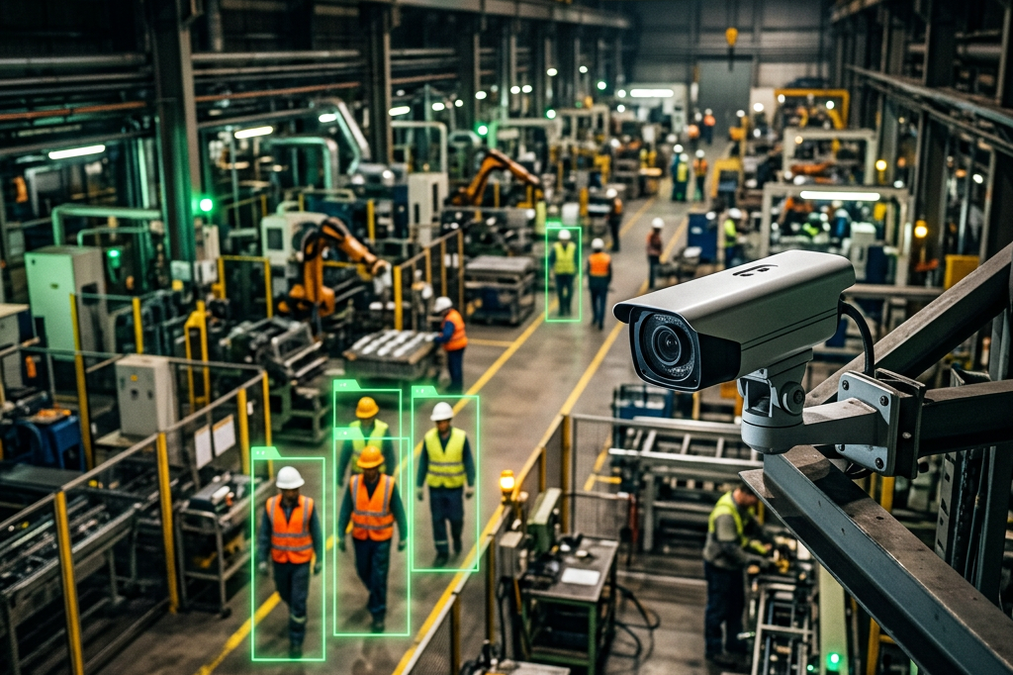
Instead of recording to review later, an AI system analyses video in real time and triggers automatic alerts when it detects a risk situation: a worker without a hard hat, a person in a restricted area, a movement pattern associated with fatigue.
It does so continuously, without tiring, without bias, without "giving the benefit of the doubt" to a trusted colleague. And it documents everything — not to investigate accidents, but to demonstrate compliance and detect patterns before they escalate.
This is exactly what Safe does: turn the cameras you most likely already have installed into an active prevention system. No construction work, no infrastructure changes, no one sitting watching a screen.
The safety technician doesn't disappear — quite the opposite. They're freed from manual review to focus on what genuinely requires human judgement: training, protocols, decisions. Safe provides the objective data; they decide what to do with it.
Where do you start?
The most common question when someone sees Safe in action isn't "does it work?" — it's "how long does it take to implement?"
The honest answer: it depends on your starting point, but much less than most people assume. In plants with IP cameras already installed, the first use cases (PPE detection, restricted zones) can be up and running within days.
What does take time — and is worth giving proper attention to — is defining what you want to detect, in which areas, and with what alert thresholds. That part isn't done by the AI: it's done by the safety team that knows the plant.
The technology provides the eyes. You provide the judgement.
Your cameras are already there
If you have cameras installed in your plant, you already have the infrastructure for an active safety system. What's missing is giving them intelligence.
The difference between a plant that documents accidents and one that prevents them isn't the number of cameras — it's what happens between the image and the alert.
Want to see how Safe would work in your plant? Let's talk — no strings attached, 30 minutes.