Your plant has cameras. Probably dozens. But when an accident occurs, the ORP technician reviews the recordings afterwards. The system recorded everything — and did nothing.
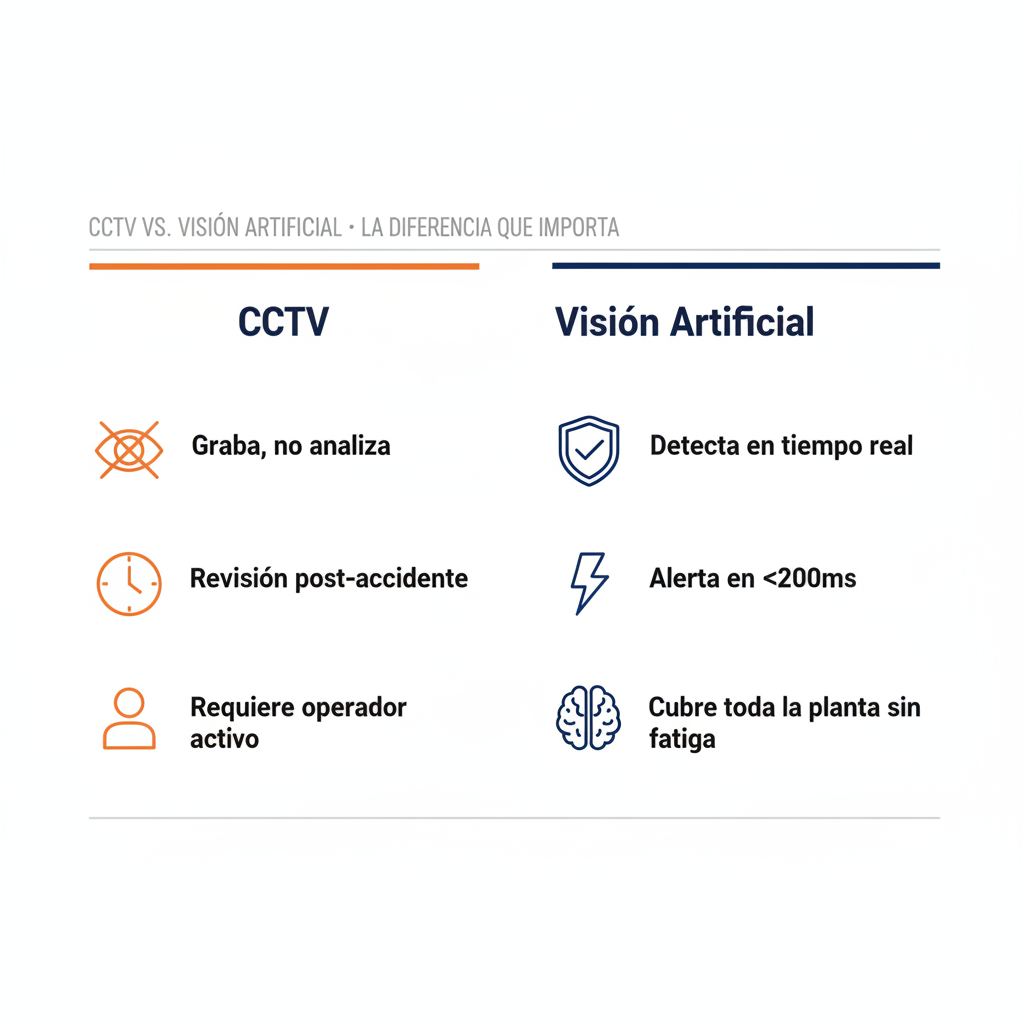
That is the difference that matters: a CCTV camera stores what happens. A computer vision system acts while it is happening.
What a CCTV camera does
CCTV fulfills a specific function: capturing and storing images. Your security manager can review what was recorded after an incident, identify what happened and use it as evidence. For that it works well.
What it cannot do is detect that an operator has spent three shifts without putting on a helmet in the loading area, or that two forklifts are about to pass each other in a blind aisle. That requires real-time analysis — and CCTV doesn't analyze anything.
What computer vision adds
An artificial vision system connects the same cameras to AI models trained to recognize behaviors, postures, objects and risk situations. The result is not better recording — it's active detection.
When a worker enters a restricted area without PPE, the system detects it in less than 200 milliseconds and sends an alert to middle management before the risk materializes. Your ORP technician doesn't have to look at 40 screens in parallel — the system alerts him or her when something needs attention.
The differences that affect your accident rate
Response time: CCTV depends on someone watching. Artificial vision alerts in real time, reducing response time by up to 75% according to data from Benchmark Technologies.
Effective coverage: an operator can monitor between 4 and 6 cameras with sustained attention. An AI system analyzes the entire plant simultaneously without fatigue.
Prevention vs. documentation: CCTV documents accidents. Computer vision prevents them by detecting the behaviors that precede them.
Continuous learning: AI models improve over time. They identify risk patterns specific to your plant that no generic protocol captures.
70% of serious accidents in industrial environments have detectable previous signs. CCTV records them. Computer vision interrupts them.
Why many plants have CCTV but still have accidents
The installation of cameras generates a feeling of control that does not always correspond to operational reality. Your security manager knows that no one can review the recordings from 60 cameras distributed in three warehouses in real time. The system exists, but it does not prevent.
The problem isn't the cameras — it's what they do with the image. An artificial vision system converts this existing infrastructure into an active prevention system without the need to replace hardware.
When does it make sense to take the step?
Not all plants need the same level of analysis. But there are three situations where the difference between CCTV and machine vision is critical:
High risk areas with mixed traffic of people and heavy machinery.
Production lines with strict PPE requirements where compliance is difficult to verify manually.
Plants with high turnover where new operators concentrate the highest percentage of incidents.
In these environments, the time between the risk and the response determines whether or not there is an accident. CCTV does not shorten that time. Artificial vision yes.
How Safe works on your current infrastructure
Safe connects to the cameras you already have installed. It does not require replacing hardware or installing additional sensors. The system analyzes the video in real time, detects risk situations and alerts the person in charge on duty with sufficient context to act.
Your PRL technician is no longer the one who reviews recordings after incidents. Become the one who receives alerts before they happen.
Request a demo of Safe and see how it works with your current cameras